Copper Toxicosis
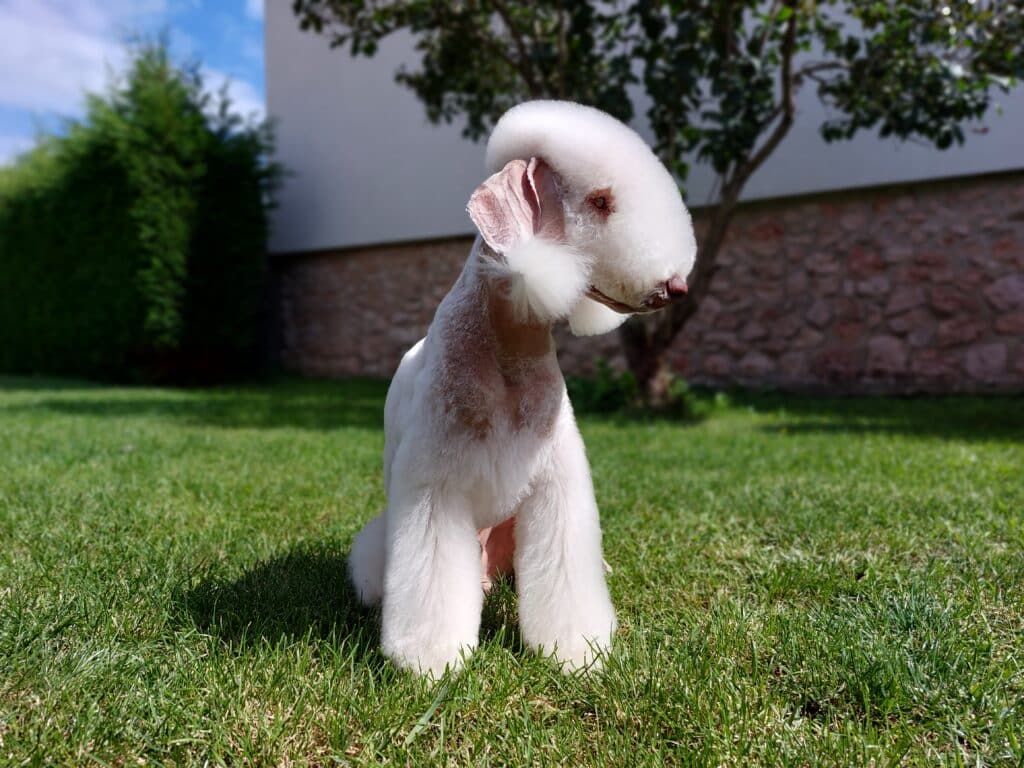
Copper Toxicosis is a potentially fatal inherited disorder that affects a small number of dog breeds, including the Bedlington Terrier.
Responsible breeders only include dogs in their breeding programmes that have tested clear (N/N) through DNA testing.
The disease causes copper to gradually accumulate in the liver, leading to liver damage and progressive liver disease, and it often results in premature death if left untreated.
When diagnosed at an early stage, the condition can usually be managed successfully with appropriate medication and a carefully controlled diet, allowing affected dogs to maintain a good quality of life for many years. For this reason, DNA testing is also recommended for pet dogs that are not intended for breeding.
Laboklin
Progressive Retinal Atrophy
The progressive retinal atrophy as an inherited form leads to a degeneration of the retina and results in blindness. The Retina which is composed of photoreceptor cells as well as nerve cells covers the back inside wall of the eye and is responsible for image formation. The photoreceptor cells can be divided into rods or cones depending on their function. The rod cells are specialised for the mesopic vision and contrast sensitivity. The con cells are responsible for color vision. The prcd-PRA causes initially a loss of function of the rod cells accompanied by night blindness. At later stages the cone cells become affected leading to a complete blindness of the dog. Age of onset of clinical symptoms is typically in early adolescence or early adulthood. However, the onset of the disease may vary among different dog breeds.
The genetic mutation responsible for the disease can be identified by DNA testing, allowing its inheritance to be reliably monitored through genetic screening.
Distichiasis
A distichia (plural distichiae) is an extra eyelash that grows from the margin of the eyelid through the duct or opening of the meibomian gland or adjacent to it.
Distichiasis means that your dog has extra eyelashes, which come out in the wrong place on the lid margin. In some dogs, the lashes are soft and do not cause a problem whilst in others, the lashes can be stubby and cause varying levels of irritation as they rub on the eye.
It can be detected through an eye examination; however, this only reflects the condition at the time of the examination. Abnormal eyelashes are replaced continuously, just like normal eyelashes.
CDDY / IVDD
Chondrodystrophy (CDDY) is a skeletal disorder characterized by shortened limbs and premature degeneration of the intervertebral discs, which may predispose dogs to intervertebral disc disease (IVDD) and disc herniation in certain breeds.
This variant is considered a risk factor, and some dogs carrying one or even two copies of the variant may never develop signs of intervertebral disc disease. Additionally, not all dogs affected by IVDD carry this variant, indicating that other genetic and environmental factors may also contribute to the development of disc disease.
The significance of this variant and its association with IVDD may vary between breeds. Other factors, including breed background and environmental influences, may also affect an individual dog’s overall risk.
CDDY is not a disease, but a genetic mutation (variant). The presence of the CDDY variant in some Bedlington Terriers is still in a very early stage of research as of 2026.
At present, there is no evidence demonstrating that CDDY poses a genuine health risk to the Bedlington Terrier breed or that it increases the risk of developing IVDD (intervertebral disc disease) in this breed. Research is still ongoing, and further data are needed to determine whether there is a meaningful association between the CDDY variant and IVDD in Bedlington Terriers.
We test our dogs for CDDY in order to contribute their results to the available data and, in doing so, support ongoing research into this variant within the breed.
If you own a Bedlington Terrier, you can also contribute to this research.
Please contact us for further information.